Hiển thị các bài đăng có nhãn Kabul. Hiển thị tất cả bài đăng

Thứ Hai, 2 tháng 11, 2015

No... Still Not Safe To Travel To Mogadishu Or Anywhere Else In Somalia... Nor Afghanistan


I was surprised by this New York Times headline Sunday night: Popular Hotel In Somalia Is Bombed By Militants. How is it possible that Mogadishu has a popular hotel? I mean who goes to Somalia and stays in a hotel? Sunday terrorists blew up the front gate of the Sahafi Hotel and then started shooting guests and workers, at least 14 of them.
If there is one hotel everyone knows in Mogadishu, it is the Sahafi. Warlords and militants alike used to hang out and plot schemes in the lounge and courtyard while sipping grapefruit juice and pulling apart camel meat steaks.

Sahafi means journalist in Arabic, and for years the hotel has served as the gateway to one of the world’s most dangerous countries for foreign journalists, aid workers and the rare brave businessman. Even in the hardest times, the staff managed to provide clean rooms and good food. Lobster was one of the house specialties, served alongside mountains of French fries. Recently, the hotel was a popular rendezvous spot for officials from Somalia’s fledgling government.

Mogadishu may be safer than it used to be, but it is still not safe. The Shabab once controlled much of the city, bullwhipping women and terrorizing the population by enforcing a harsh version of Islamic law. But even after being pushed out by African Union troops, Shabab fighters have shown they can strike anywhere at any time.

Somalia’s government tried to play down some of the concerns stirred up by the attack. President Hassan Sheikh Mohamud of Somalia said on Sunday, “We want to confirm that such terrorist acts does not mean Shabab’s revival, but in the contrary shows clear signs that they are in desperate situation.”
This is the warning posted on the top of the Wikitravel site for Mogadishu: "There is a high threat from terrorism, including kidnapping, throughout Somalia, excluding Somaliland. Terrorist groups have made threats against Westerners and those working for Western organizations. It is known that there is a constant threat of terrorist attacks in Mogadishu. The city also remains in great danger of suicide bombings and other terrorist attacks carried out by extremists who manage to get past security checkpoints around the city. Walking the streets of Mogadishu remains very dangerous, even with armed guards. Tourists are emphatically discouraged from visiting Mogadishu for the time being, while business travelers should take extreme caution and make thorough plans for any trips. Travel outside Mogadishu remains extremely dangerous and should be avoided at all costs. Those working for aid agencies should consult the security plans or advice of your organization."

5 airlines fly into Aden Adde International Airport a few miles from Mogadishu: Somalia's own Jubba Airways, African Express Airways, which flies to Abu Dhabi, Dubai and Nairobi, Daallo Airlines, which flies to Hargeisa (with a stop in Djibouti), East African, which lies to Nairobi on Sundays and Turkish Air, which flies twice a week to Istanbul via Khartoum or Djibouti. What's to see? "Sightseeing is obviously extremely dangerous in Mogadishu, and is strongly discouraged. However, some interesting sites include the historic Mogadishu old town and the Mogadishu mosque." OK, what's to do? "Visitors are encouraged to stay inside for the duration of their stay. The chances of theft and/or assault are extremely high while walking around the city." And to buy? "The Bakaara Market (Suuqa Bakaaraha) is an open market and the largest of its kind in Somalia. Created in late 1972 during the reign of Siad Barre, its original purpose was to allow proprietors to sell daily essentials, but the civil war subsequently created demand for arms and ammunition. Everything from pistols to anti-aircraft weapons are being sold here. Falsified documents are also readily available, such as forged Somali, Ethiopian and Kenyan passports. This illicit submarket is known as Cabdalle Shideeye after one of its first proprietors. Most markets and are a focus of ongoing arms control efforts for the disarmament of Somalia. Marketplaces should be considered hazardous not only because of their content and the presence of unsavory characters, but also due to the fact that they have caught fire several times in the last few years." The food is rumored to be safe to eat at the Sahafi Hotel, the one that just got blown up.

Trip Advisor has no reviews but gives it a nice 4.5 stars and ranks it #2 in Mogadishu.

I remember when I first got to Afghanistan in 1969, 2 of my passengers, Canadians Nate and... I want to say Nate and Al, but that's a deli in Beverly Hills... maybe it was Nate and Kevin. 45 years a long time. Anyway, I slept in my VW van but they settled into the posh-- for Afghanistan-- Intercontinental Hotel just outside town. They went to local pharmacy near the royal palace, bough a huge bag of pharmaceutical cocaine and settled into the Intercontinental, which had just opened a month before we got there-- the first luxury hotel in the country-- and was pretty empty. 200 rooms but I never ran into anyone in the living quarter floors but Kevin and... let's say Kevin.

Eventually it was taken over by Russian military officers when they invaded. Then it was used for target practice by the Taliban, leaving only 85 habitable rooms. Once the U.S. invaded the country, Western Journalists started staying there. In 2011 there was a suicide bombing and a few dozen people were killed. Today there are 13 Trip Advisor reviews giving it an average rating of 3.5 stars (although just 2.5 stars for value).

Chủ Nhật, 29 tháng 9, 2013

Kabul's Very Historic Garden Of Fidelity

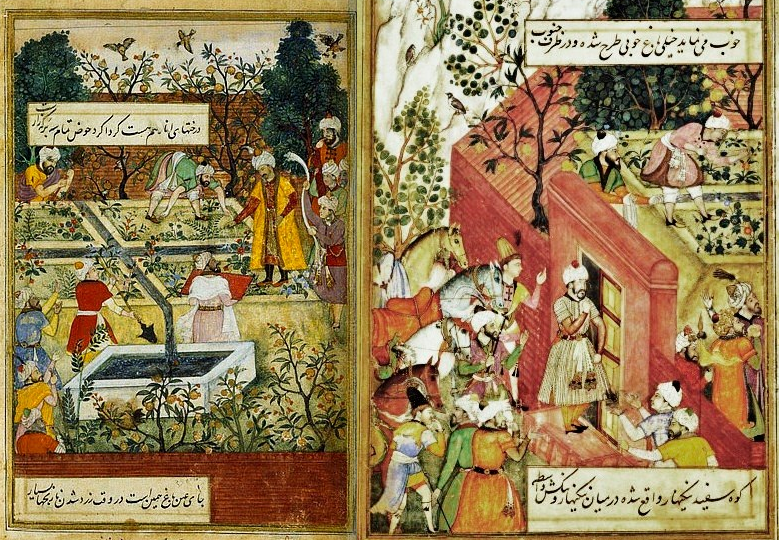
2 paintings of Babur laying out the gardens

I was lucky I got to travel through Afghanistan when I did, in 1969 and again 1971. After that the whole thing blew up and today when Westerners think of Afghanistan, they think of off an ugly, dusty, crumbling, violent landscape. When I think of the "best" countries I ever visited, Afghanistan is always high on the list. And countries get on that list because of the people more than anything else. The Afs were always incredibly friendly and hospitable, even when I got thrown into jail for trying to smuggle 50 kilos of hash out of the country in my van.

Unfortunately, in the last decades Afghanistan hasn't been a place for foreign visitors. A Taliban spokesman a few months ago: “It is part of our war strategy to target any foreign citizen whose country has a military presence in Afghanistan and enters our country without permission from the Islamic Emirate of Afghanistan." A few tourists go anyway, maybe 100 a year, fewer than when I was first there in 1969. A Canadian couple disappeared and haven't been heard of since. Another two were a wealthy Russian couple, who hired an armored car and bodyguards at $1,500 a day, stayed in the $356-a-night Kabul Serena Hotel, toured the Panjshir Valley, and went home on schedule.
Like tourism industries anywhere, Afghan tourism does have its boosters. “The security situation is fairly stable, and tourists who visit are fairly comfortable and they are pleased when they see a hotel of this standard,” said Shahryar T. Khan, the general manager of the Kabul Serena Hotel, which has five stars and “world-class security measures.”

The 177-room hotel runs at 64 percent occupancy, Mr. Khan said, and tourists make up an increasing share of the guests. “Of course, from zero it’s gone up to 1 percent.” The Serena has twice been attacked by terrorists, and in 2008 Taliban insurgents killed six guests in an attack aimed at the hotel’s health spa.
Ghulam Nabi Farahi, the deputy minister of tourism says “Afghanistan is a country very suitable for attracting tourists. It’s a place where tourists can have all their wishes come true.” And he insists that there have been no recent cases of tourists attacked or kidnapped. The WikiTravel site for Afghanistan has a bold warning on top telling would be visitors that travel there "is extremely dangerous, and independent travel/sightseeing is emphatically discouraged."

But this week, a friend turned me on to a blog by Barbara Wells Sarudy who expresses a beautiful historical appreciation for Afghanistan-- or at least for the Afghanistan of the 1500s-- and from a unique perspective.
The Bagh-e Vafa (Garden of Fidelity) was Babur's first garden in what is now Afghanistan. He wrote in his memoirs, "In 1508-09, I had constructed a charbagh garden called Bagh-i-Wafa on a rise to the south of the Adianapur fortress. It overlooks the river, which flows between the fortress and the garden. It yields many oranges, citroens and pomegranates."

What is known about its design also comes from Babur's memoirs, "There oranges, citrons and pomegranates grow in abundance...I had plantains brought and planted there; they did vedry well. The year before I had had sugar cane planted there; it also did well...The garden lies high, has running water close at hand, and a mild winter climate. In the middle of it, a one-mill stream flows constantly past the little hill on which are the four garden plots. In the southwest part of it there is a reservoir ten by ten, round which are orange-trees and a few pomegranates, the whole encircled by a trefoil meadow. This is the best part of the garden, a most beautiful sight when the oranges take color."

This type of garden, called a charbagh, was described earlier in an account from Sir John Mandeville’s travels into the East, c. 1370, “And this Paradise is enclosed all about with a wall…and in the most high place of Paradise, even in the middle place, is a well that casteth out the four floods that run by divers lands. Of the which, the first is clept Pison, or Ganges, that is all one; and it runneth throughout Ind or Emlak, in the which river be many precious stones, and much of lignum aloes and much gravel of gold. And that other river is clept Nilus or Gison, that goeth by Ethiopia and after by Egypt. And that other is clept Tigris, that runneth by Assyria and by Armenia the great. And that other is clept Euphrates, that runneth also by Media and Armenia and by Persia. And men there beyond say, that all the sweet waters of the world, above and beneath, take their beginning of the well of Paradise, and out of that well all waters come and go.”

Charbagh is a Persian-style garden layout. The quadrilateral garden is divided by walkways or flowing water into four smaller parts. In Persian, "Char" means "four" and "bagh" means "garden." Chahrbagh originated from the time of Achaemenid Persia. Greek historians, such as Herodotus and Xenophon, give extensive accounts of Cyrus the Great's palatial city of Pasargadae and his four-gardens.

The Gardens of Babur, also called Bagh-e Babur, is today a historic park in Kabul, Afghanistan, and also the last resting-place of the first Mughal emperor Babur. The gardens are thought to have been developed in the early 1500s, when Babur gave orders for the construction of an "avenue garden" in Kabul, described in some detail in his memoirs, the Baburnama.  Today, many species chosen for replanting are specifically mentioned in the Baburnama, including walnut, cherry, quince, mulberry and apricot trees.

The Baburnama was the first autobiography in the Muslim world. It is the memoir of Zahir ud-Din Muhammad Babur (1483-1530), founder of the Mughal Empire & a great-great-great-grandson of Timur. It is an autobiographical work, originally written in the Chagatai language, known to Babur as "Turki" (Turkic), the spoken language of the Andijan-Timurids. Because of Babur's cultural origin, his prose is highly Persianized & contains many phrases & smaller poems in Persian. By 1590, the autobiography was completely translated to Persian by a Mughal courtier, Abdul Rahim, in AH (Hijri) 998 (1589-90). Babur & his successors introduced a level of Persian sophistication into Northern India, founding the last dynasty of India, the Mughal Dynasty.

Babur begins his story at age 12. His father had died, & he had inherited & lost a kingdom in the lush Ferghana Valley north of Afghanistan. As a teenager, Babur captured Samarkand, only to lose it. In his early 20s, Babur seemed to strategize more. He took to the forests, where he lived for 3 years, slowly building & training an army. He had an Empire to establish.

When he was ready, he crossed the Hindu Kush mountain range, & captured Kabul, a city he grew to love. In his autobiography, he described Kabul, “It is a pretty little province, completely surrounded by mountains. This province is a mercantile center. From India, caravans of 10, 15, 20 thousand pack animals brings slaves, textiles, sugar, & spices. Many Kabul merchants would not be satisfied with 300 or 400% profit! Goods from Iraq, Antonia, China, [& beyond] can be found in Kabul.”

While in Kabul, he designed a garden. Gardens were part of his homeland, which he missed. There, they tended to be walled enclosures with water channels which ran at regular intervals, cross-sections. And that’s what he recreated, a garden with terraces & running water. The water adds background noise & the fragrance from blossoms, as it cools. When he brought water to the dry, dusty landscape, it became fertile. Water transforms the land into an image of paradise. The Garden of Eden, the Promised Land.

Despite his adoration of Kabul & his garden, Babur was not ready to retire. He conquered Kandahar, another wealthy city along prosperous trade routes. He crossed the Oxus River & conquered his ancestral lands of the Ferghana Valley. He then set his sights on India. He used the newest technologies; & his battalion of 12,000 was able to defeat an army of 100,000. He sacked what is today Northern India. He & his descendants ruled the subcontinent for 3 centuries, instilling a legacy of Persian culture & Islamic faith.

"If there is a paradise on earth, it is this, it is this, it is this!" reads the inscription on Babur’s tomb in his Kabul Garden. Babur died in Northern India, but was later brought back to Kabul & was laid to rest in his beloved garden.
I don't recall ever seeing it. Now I want to go back to check it out!